When Evelyn McLeod first felt the sharp, unfamiliar pain beneath her ribs, she considered the drive to Brandon’s Regional Health Centre and the two-hour wait that would follow. At 72, with limited mobility and a fear of getting lost in a hospital crowd, she stayed home and called her daughter. Within 48 hours a paramedic was at her doorstep, not to whisk her away, but to sit on the kitchen chair where Evelyn talked about her arthritis, her sleep, and the new medicine that made her dizzy.
"She knew me by name before she even sat down," Evelyn said. "I felt like someone had thought of me first, not my chart."
Evelyn’s moment is a small hinge in a larger story unfolding across Westman — a coalition of towns and organizations that have quietly reimagined how health care reaches rural lives. The initiative, coordinated locally under the umbrella Westman Health Access Network, brings together Prairie Mountain Health, municipal leaders, family physicians, paramedics, and community groups to deliver services in homes, schools and community halls. It is not a single program but a weave of practical responses: mobile clinics that park in town squares, community paramedicine teams that provide in-home chronic-care support, and low-barrier mental-health hubs offering walk-in counselling.
There was no sudden infusion of funds; the project grew out of necessity. Over the last decade, clinic closures and recruitment challenges hardened the distances between people and providers. "People were waiting too long, or they stopped seeking care altogether," said Dr. Aisha Khan, a family physician who helped design the network’s primary-care outreach. "We kept hearing: ‘We can’t get in, we don’t trust the system, who will see us?’ That urgency forced a different way of thinking — care with feet on the ground."
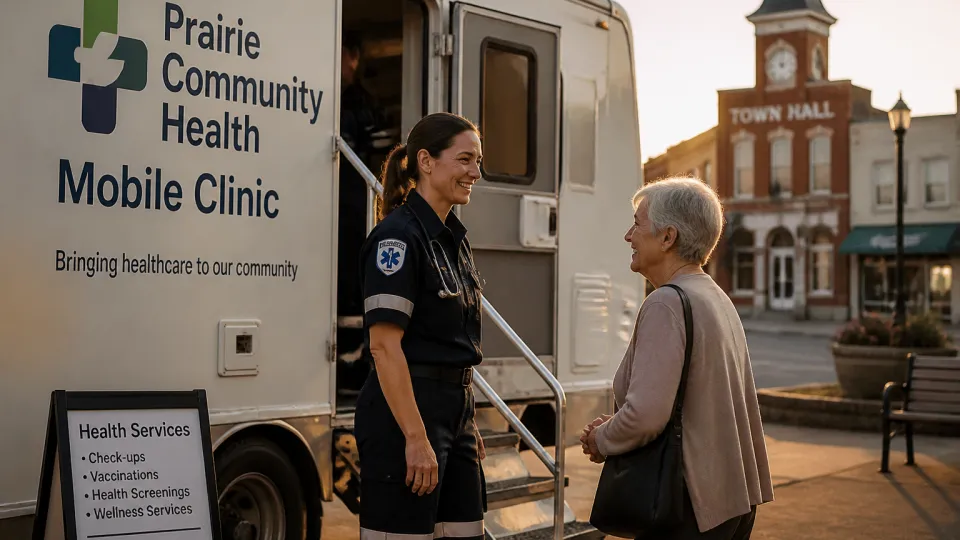
The mobile clinic, branded Health on Wheels, operates on a schedule announced on local radio and social media, touching down in towns like Rivers, Neepawa and Virden. Staffed by a rotating team of nurses, nurse practitioners and a family physician, the van offers everything from vaccines to diabetes checks. For farmers who can’t leave a field during seeding, the clinic has been decisive. "We see people who would otherwise delay a check-up for months," said Tom Richards, a community paramedic. "When you treat high blood pressure early, you avoid hospitalizations down the road. The math is simple, but it’s easy to forget when systems are siloed."
Community paramedicine is perhaps the most intimate of the efforts. Paramedics received additional training to manage chronic diseases, do wound care, and coordinate with social supports. Their visits reduce the blunt instrument of an ambulance ride to emergency and instead steer patients to the right care — a pharmacist for medication review, a home-care aide for bathing, a counsellor for anxiety.
Mental health has been an especially visible fracture-point. Long waits and stigma pushed many into crisis before help arrived. In response, the network partnered with community organizations to create Open Door hubs — daytime spaces where residents can get walk-in counselling, peer support and referrals. "People come in and say, ‘I just needed to talk,’" said Claire Fontaine, a social worker who runs the hub in Brandon. "We meet them where they are, and that keeps more people out of crisis and connected to ongoing supports."
The human impacts are quiet but consequential: fewer repeat emergency visits, better medication adherence, and patients who feel seen. For Evelyn, the home visit led to a change in medication and a referral to a local physiotherapist. "I sleep better now," she said. "But more than that, I don’t feel invisible."
The initiative’s gains do not erase its questions. Funding is patchwork, relying on municipal grants, provincial pilot programs, donations and volunteer time. Workforce shortages persist; training paramedics to deliver community-based care helps, but the region still needs more providers and better retention strategies. Leaders speak candidly about the risk of brilliant pilots dissipating without stable investment.
There are broader policy implications. The Westman experiment shows the limits of centralized responses and the promise of flexible, community-rooted care. Telehealth has been useful, but it cannot replace a nurse’s hand on a wound or the warmth of a counsellor in a storefront. The network also points to the importance of local governance: when municipal leaders, health authorities and community groups shared decision-making, solutions were quicker and more responsive.
Looking ahead, those involved are pressing for a hybrid model: sustainable provincial funding for proven locally led programs, expanded training for community paramedics and formal pathways to link these services with primary-care rosters. They also want to strengthen relationships with Indigenous communities and ensure culturally safe care.
"Our work isn’t about a hero program," Dr. Khan said. "It’s about building infrastructure that recognizes the realities of rural life — distance, seasonality, and social connection. When we design services around people, not institutions, care becomes accessible and humane."
Evelyn’s final reflection captures the quiet revolution at the network’s heart. "It’s about being part of a place again," she said. "When someone knocks on your door because they know your name, you start to believe the system is for you. That changes everything."
The Westman effort is not a panacea. But as other rural regions grapple with similar dilemmas, Brandon and its neighbours offer a pragmatic lesson: durable rural health solutions begin with listening, follow through with grounded logistics, and demand policy that recognizes care must arrive where people live their lives.